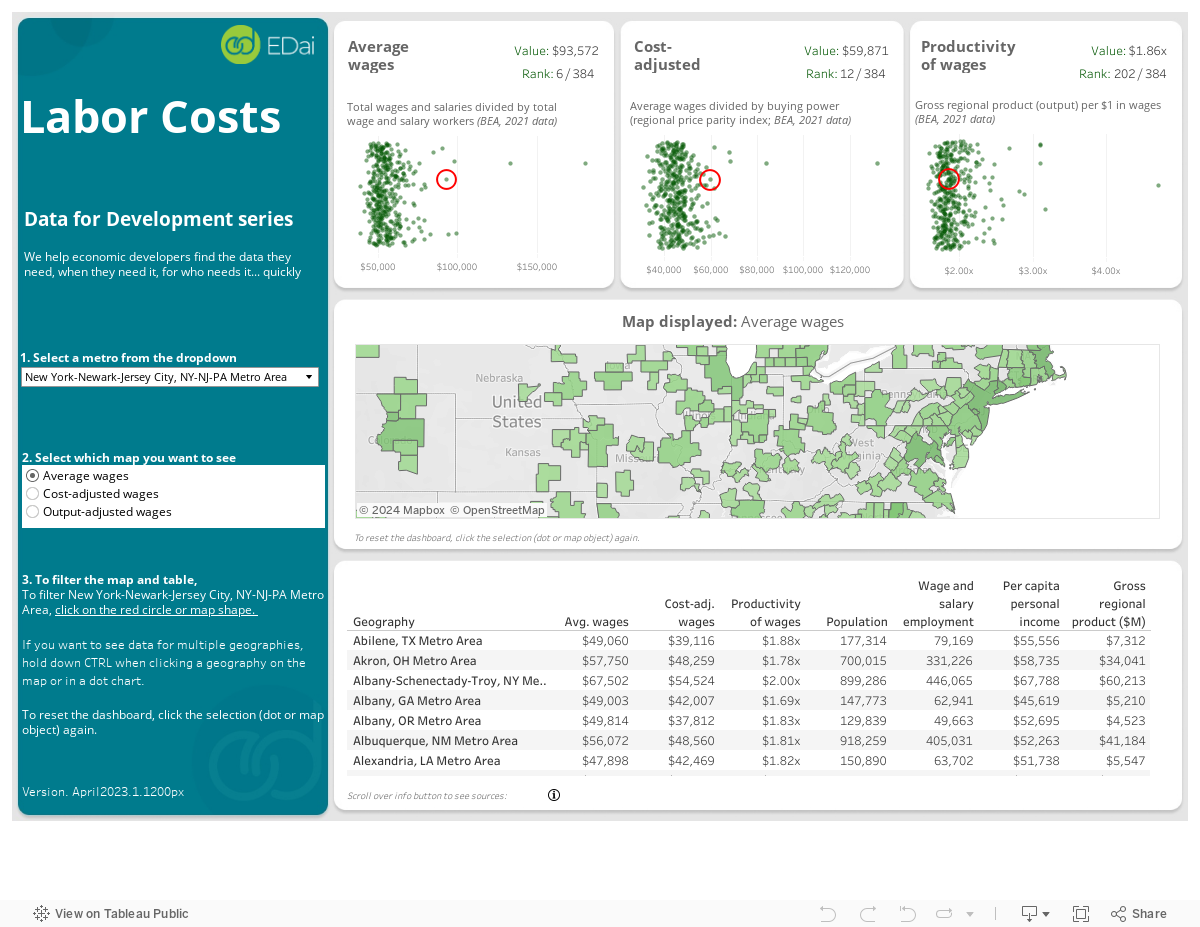
Labor costs ranked first among corporate executives in Area Development's annual survey of location decision factors — ahead of incentives, energy, transportation, and everything else. The reason is straightforward: labor typically represents the largest single share of operating costs for any industry, and differences across markets compound significantly at scale.
But "labor costs" is not a single number. A raw wage comparison tells you something. Fully-loaded compensation — wages plus benefits, payroll taxes, workers' comp — tells you more. And after-tax operating cost, which factors in how state and local tax structures affect the bottom line, tells you what the decision actually looks like on a P&L. Each definition can change which markets look attractive and which ones don't.
This dashboard visualizes all three across 100+ U.S. metros, letting you compare markets at the level of specificity your decision actually requires.
The question this dashboard answers
"Where can I find the labor I need at a cost my business model can actually support?"
Raw Wages
Median and average wages by occupation and industry across 100+ metros. The most common starting point for labor cost comparisons.
Fully-Loaded Compensation
Wages plus benefits, payroll taxes, and workers' compensation — the real cost of an employee to the employer, not just the number on the offer letter.
After-Tax Operating Cost
How state and local tax structures affect total labor cost on a P&L basis. The measure that most directly reflects the location decision as a business case.
About the data
Wages
Bureau of Labor Statistics Occupational Employment and Wage Statistics (OEWS), MSA-level data. Median and mean wages by occupation and industry.
Benefits & taxes
Bureau of Labor Statistics Employer Costs for Employee Compensation (ECEC). State payroll tax and workers' compensation rates sourced from state agencies.
After-tax operating cost
EDai modeling incorporating state and local corporate income tax, property tax, and sales tax structures to estimate fully-loaded operating cost by metro.